| Table 1. Research sample of the multiple case study. | |||||
| Company | Sustainability-oriented service(s) | Founding year | Annual turnover, EUR (year 2023) | Nr of personnel | Interviewee position |
| 1 | Carbon sequestration | 2019 | 1000 | 2 | CEO |
| 2 | Carbon sequestration and restoration | 2020 | 55 000 | 4–5 | CEO |
| 3 | Carbon sequestration and environmental consultation | 2019 | 838 000 | 17 | Founder |
| 4 | Sustainable forest management/cooperative forest incl. continuous cover forestry | 2020 | 917 000 | 3 | CEO |
| 5 | Circular economy, recycled wood | 2023 | 57 000 | 6 | Innovation manager, Founder |
| 6 | Sustainable forest management incl. continuous cover forestry | 2007 | 784 000 | 6 | CEO |
| 7 | Giftshop for tree planting and nature conservation | 2021 | 143 000 | 2 | Vice president |
| 8 | Sustainable forest management incl. restoration services, continuous cover forestry | 2022 | 267 000 | 3 | CEO |
| 9 | Health services in forests | 2016 | 298 000 | 2 | CEO |
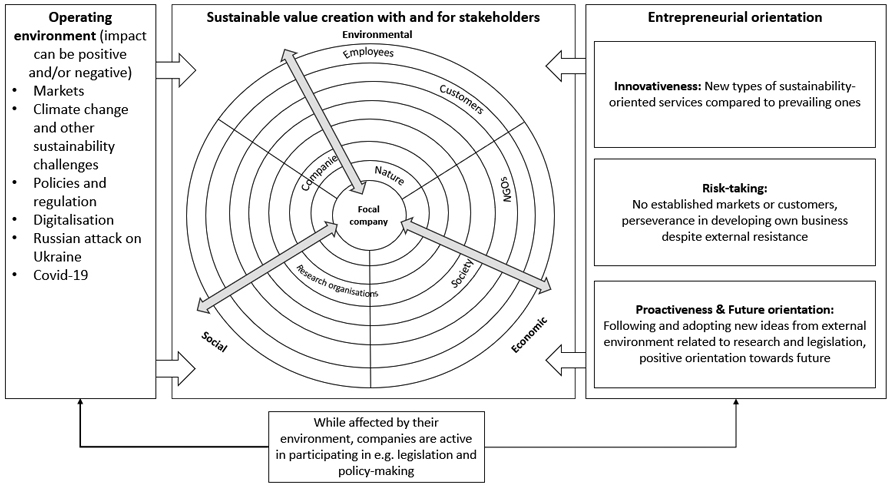
Fig. 1. The relationship between SMEs’ operating environment, entrepreneurial orientation and sustainable value creation. The layers of the circle represent the most important stakeholder groups in no particular order, and the three sections represent environmental, social and economic value creation. The three grey arrows describe mutual processes of how value is created both with and for stakeholders.
| Table 2. A synthesis of the main empirical findings representing the relationship of the case companies’ operating environment, entrepreneurial orientation and sustainable value creation. | |||
| Findings | Citations | ||
| Reacting to operating environment | Current | Right timing for establishing sustainable business since expertise and resources are available Governments’ role has been mostly deteriorating for developing sustainable business Sustainability-oriented services are offered due to the demand of sustainable use of forests and related business Old established structures, practices, long value chains and actors in the forest-based sector have hampered the development of sustainability-oriented companies, yet such resistance has created a push towards creating sustainable value | “Then at wildest, on the IPCC report’s publishing day, 65 people donated [money for restoration activities]” (Company 3) “The role of the state now in utilising the carbon sink of Finnish forests, […]. That’s the biggest challenge.” (Company 1) “In service-based entrepreneurs and forest wealth management there has been a need for years to be able to create revenues through other ways, other than just wood-production.” (Company 3) “Transparency hasn’t been great in the forest sector, so we have brought transparency to economic value creation.” (Company 4) |
| Changes | Increasing sustainability regulation can enhance possibilities to create sustainable value but also can have negative effects Increasing sustainability challenges have and will create more demand for sustainable value creation Digitalisation has enhanced effectiveness Sudden changes such as Covid-19 and Russian attack to Ukraine considered as negative for business development, yet positive for nature | “We have to be able to advice our customers in the changing regulative environment, that everything goes right in terms of regulations and standards, […], we have to stay awake of what is demanded and which methods are used…” (Company 4) “What has helped, has been the development of legislation, and that’s a big thing for us that it has happened in Finland but also in EU level, they will go towards sustainable development […]” (Company 5) “Another big challenge is climate change. […] How can we adapt our services so that we can try to mitigate and limit it.” (Company 6) “We also have that [name of a service] forest information system and there AI-based tools, and you can analyse based on aerial photos where bark beetle damages are […]” (Company 8) “Then Covid-19 came and planes were left at airports, people were left at home, so then there was a clear decrease here in compensation. If compensation is done as a climate act, it is better to stop world with Covid - relative to climate.” (Company 2) | |
| Employing entrepreneurial orientation | Innovativeness | Innovative ways how sustainable value is created e.g., through enhancing carbon sequestration, restoring ecosystems, and strengthening human-forest relationship, that differ from the traditional forest-based sector and related services | “We thought up taking people to forest, […], so that there were a doctor, a physiotherapist and an occupational therapist involved giving guidance.” (Company 9) “Circular economy has been the main theme in the activities we do and to do it as nature friendly as possible. And so that no trees would have to be cut and put to energy use because of our activities” (Company 5) |
| Proactiveness & future orientation | Providing sustainability-oriented services in the front line while following development actively Oriented positively towards future and considering own business as a solution to sustainability challenges Contributing to sustainability legislation and regulation development Following actively related policy development and research | “Climate compensation and work for climate or revenue gained from it, has featured for a long time, and then when nothing started to happen, we got the idea that we have to figure it out by ourselves” (Company 3) “[…] whether it is EU-policies, or private forest owner who starts to dig ditches to peatland […] I do believe that there is even more demand for our message and idea.” (Company 6) “This change in legislation in continuous cover forestry, in which we were quite strongly involved in the background.” (Company 6) “Surprisingly big part is mapping and keeping up with this climate and ecological restoration related scientific information and topical information. It is actually quite an important activity and the whole group does it because everything cannot be reached by one person.” (Company 2) | |
| Risk-taking | No established markets or regulation for such sustainability-oriented business (can also result as value destruction) Developing services that challenge the current practices of the established forest-based business based on wood production Following own values considered as more important than economic gains Financial risks minimised | “And then another risk is that this cooperative forest concept doesn’t break through and this [own business] will remain as… this is an ok business for us, but this is still marginal in terms of the forest sector” (Company 4) “We have security of supply and transparency, of which I am proud of and have been criticised by some large companies” (Company 8) “Even if it was from one meter away and the cheapest contractor, but saying that they don’t understand our activities, […], we then take double times more expensive one from 5 meters away who understands and shares same value base as us.” (Company 7) “We excluded ourselves with the sustainability thinking, so that our activities are verified by anyone from nearby and from further too, so we excluded ourselves from such large sales potential.” (Company 7) | |
| Considering and engaging stakeholders | Stakeholder networks consist of actors with similar values e.g., other companies, customers, research organisations, universities, non-governmental organisations with and for whom sustainable value is created Customers and other companies in central role and with whom environmental and social value is created: customers e.g. creating demand and paying for the sustainability-oriented services, other companies e.g. executing the environmental operations, supporting rural development and ensuring transparency Environment as main stakeholder for which value is created. Forest owners and other customers as main stakeholder groups for which new alternative sustainability-oriented services are provided | “With all these activities we create forest where climate sequestration, biodiversity and recreational values are combined well.” (Company 4) “Forestry associations are partners for us, and they take care of exactly the forest owner phases, for example you need to verify the tree stand before the project” (Company 3) “Restoring nature values as a compensation possibility is our product” (Company 2) | |