
Juha Kaitera  ,
Tuula Piri,
Minna Männistö,
Sanna Vinblad,
Heli Väätäjä,
Kari Mäkitalo
,
Tuula Piri,
Minna Männistö,
Sanna Vinblad,
Heli Väätäjä,
Kari Mäkitalo
Dogs can detect the rust fungus Cronartium pini in the forest
Kaitera J., Piri T., Männistö M., Vinblad S., Väätäjä H., Mäkitalo K. (2026). Dogs can detect the rust fungus Cronartium pini in the forest. Silva Fennica vol. 60 no. 1 article id 25036. https://doi.org/10.14214/sf.25036
Highlights
- Dogs identified Cronartium pini spores, fruit bodies and young and old lesions
- Dogs identified both heteroecious and autoecious Cronartium pini
- Dogs identified Cronartium pini at the early epidemical stage of the disease
- Dogs identified Cronartium pini from latent infections in alive shoots.
Abstract
Cronartium pini (Willd.) Jørst. is a major rust pathogen that kills especially Scots pine (Pinus sylvestris L.). Early diagnosis of the pathogen would reduce significant losses in managed forest productivity. Dogs (Canis lupus familiaris L.) with their accurate sense of smell have potential to detect forest pathogens at an early stage before they cause significant losses in forests. In this study, we tested in northern Finland whether trained volunteer dog-handler teams could identify infected wood, fruit bodies, spores or mycelia of C. pini in vitro and in vivo to facilitate early disease diagnosis. Volunteer dog-handler teams were able to indicate C. pini spores, fruit bodies and both fresh and old rust lesions on Scots pine including alive shoots, where the rust was present yet as latent. Five dogs out of five detected in vitro C. pini (both life-cycle forms), with 51% mean sensitivity and 58% mean precision. Four dogs out of four detected in vivo the autoecious life-cycle form of C. pini, with 95% mean sensitivity and 89% mean precision. In in vivo detection of the heteroecious life cycle form on pine, two dogs out of two performed with 78% mean sensitivity (100% precision). For identifying C. pini on alternate hosts in vivo, the mean sensitivity was 58% (precision 100%). Trained dog-handler pairs show promise as an aid in searching for C. pini especially in Scots pine stands at their early epidemical stage, but further testing is needed.
Keywords
Pinus sylvestris;
Scots pine blister rust;
alternate hosts;
canine;
resin-top disease;
scent detection
-
Kaitera,
Natural Resources Institute Finland (Luke), Paavo Havaksen tie 3, FI-90570 Oulu, Finland
 https://orcid.org/0000-0003-2549-7001
E-mail
juha.kaitera@luke.fi
https://orcid.org/0000-0003-2549-7001
E-mail
juha.kaitera@luke.fi
-
Piri,
Natural Resources Institute Finland (Luke), Latokartanonkaari 9, FI-00790 Helsinki, Finland
https://orcid.org/0000-0001-8690-3726
E-mail
tuula.piri@luke.fi
-
Männistö,
Natural Resources Institute Finland (Luke), Ounasjoentie 6, FI-96200 Rovaniemi, Finland
https://orcid.org/0000-0001-9390-1104
E-mail
minna.mannisto@luke.fi
-
Vinblad,
Lapland University of Applied Sciences, Jokiväylä 11 C, FI-96300 Rovaniemi, Finland
https://orcid.org/0009-0009-1131-6143
E-mail
sanna.vinblad@lapinamk.fi
-
Väätäjä,
Lapland University of Applied Sciences, Jokiväylä 11 C, FI-96300 Rovaniemi, Finland
https://orcid.org/0000-0003-3324-9497
E-mail
heli.vaataja@lapinamk.fi
- Mäkitalo, Natural Resources Institute Finland (Luke), Ounasjoentie 6, FI-96200 Rovaniemi, Finland E-mail kari.makitalo@luke.fi
Received 3 October 2025 Accepted 18 March 2026 Published 27 March 2026
Views 13104
Available at https://doi.org/10.14214/sf.25036 | Download PDF

Supplementary Files
1 Introduction
Cronartium pini (Willd.) Jørst is an important rust on Pinus spp. in Europe and Asia (CABI 2009). It is a quarantine species in North America (Kim et al. 2022). In Finland, the rust is distributed throughout the country with ca. 2% of infected Scots pines (Pinus sylvestris L; Ylikojola and Nevalainen 2006). In single stands ca. 50% of the pines may be infected (Kaitera 2000; Kaitera and Kokko 2023), and in severe cases the stand has to be regenerated before full maturation if the number of healthy trees to be raised becomes too low (Finlex 2013; Metsähallitus 2022). The rust kills all size of trees, but mature trees are most severely infected (Kaitera et al. 1994). Recently, however, severe epidemics have been reported in young pine plantations in nutrient-rich soils (Kaitera 2000; Wulff et al. 2012).
The rust has a heteroecious form that spreads via alternate host plants and an autoecious form that spreads directly from pine to pine (Kaitera 2003; Kaitera and Nuorteva 2008). The C. pini populations are genetically close in northern Fennoscandia (Samils et al. 2021). The rust can spread via over 50 susceptible species (Kim et al. 2022) of which hemiparasitic Melampyrum spp., Euphrasia spp., Pedicularis spp. and Rhinanthus spp. are highly susceptible (Kaitera et al. 2015). Vincetoxicum hirundaria Medicus and Paeonia spp. are also important alternate hosts (Kaitera et al. 2005, 2017). C. pini has five spore stages: spermogonia and aecia on pines and uredinia, telia and basidia on alternate hosts. Disease symptoms include lesions and aecia on branches and stems, black resinuous wood, dead tops and death of the whole tree on pines (Kaitera et al. 1994). Infected wood contains high amounts of terpenes and resin acids (Kaitera et al. 2021). The rust is recommended to be controlled by removing infected trees during thinnings, and avoiding use of susceptible seed and susceptible sites in pine cultivation (Metsänhoidon suositukset 2025). Removal of infected trees has been effective to keep the C. pini incidence at low level nationally in Finland over decades (Ylikojola and Nevalainen 2006; Hantula et al. 2023). Removal of infected trees during thinnings has also been recommended in Britain (Pawsey 1964) and in southern Europe (Diamandis and Perleron 2003). However, in a stand with high disease incidence and long disease history, thinning did not reduce significantly C. pini incidence shortly after thinning (Kaitera 2002). This was probably due to high susceptibility of the pine provenance and high number of latent infections invisible to naked eye on trees during management that progressed to disease symptoms shortly after thinning. Susceptibility of pine to C. pini is inherited and known to affect highly C. pini incidence (Pawsey 1964; Persson et al. 2024), which information can be utilized in future breeding programs to increase pine resistance to C. pini and improve disease control (Persson et al. 2024).
Dogs (Canis lupus familiaris L.) possess highly developed olfactory senses and have been successfully trained to detect various non-biological (e.g., ores, explosives, chemical contaminants, and drugs) and biological scents (e.g., animal and plant species, mushrooms, and several human diseases) (Browne et al. 2006). Dogs have also been used to detect tree pathogens and insects. They can identify trees attacked by bark beetles (Vošvrdová et al. 2023), and pathogenic fungi, Phytophthora spp. (P. ramorum Werres, De Cock & Man in’t Veld), in oaks (Quercus spp.; Carter et al. 2023). Although training dogs to detect pathogens offers great potential for forest pathology by detecting latent infections and early disease symptoms, it has not been utilized so far for rust fungi. Recently, dogs were successfully trained to detect Heterobasidion spp. in natural forest environment (Kaitera et al. 2025). Dogs are also able to detect H. parviporum buried in the soil and water extract from infected wood applied on the ground surface (Swedjemark and Morrison 1987; Wysocka 2021).
Since C. pini is difficult to identify especially in young living trees due to long latent period before visible symptoms and on alternate hosts with small size of fruit bodies, we investigated the potential of dogs’ sense of smell for detecting C. pini in pine forests. We hypothesised that dogs could be trained to recognise C. pini already at an early stage of infection.
The aim of this study was to clarify if dogs can be trained to detect the scent produced by C. pini in trees and plants to improve early detection and therefore, forest health. Early detection would enable timely implementation of control measures, preventing C. pini epidemics.
2 Materials and methods
2.1 Collection and preparation of samples
Aeciospores, young sporulating and old sporulated lesions carrying C. pini aecia were collected in June 2021 (Fig. 1), and leaves of Paeonia lactiflora Pall., Impatiens balsamina L., Melampyrum sylvaticum L., Euphrasia sp. and Rhinanthus minor L. carrying uredinia or telia of C. pini, were collected in July-August 2021 and August 2022. Aeciospores were dusted aseptically into glass jars, while lesions with aecia were split into 1–2 cm segments. Leaves with C. pini uredinia or telia were separated from rest of the leaf material aseptically directly to glass jars. Rust material was collected in total of 91 glass jars (Table 1).
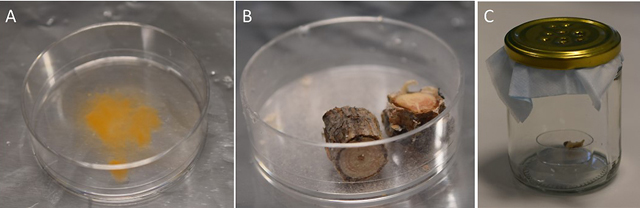
Fig. 1. Aeciospores (A) and pieces of lesions (B) of Cronartium pini on Petri dishes and a jar with a covid mask (C).
| Table 1. Samples of Cronartium pini and controls used in scent discrimination. Bolded target (fungal source) and nontarget (control source) samples were used in the final indoors scent discrimination tests. CF = Heteroecious life-cycle form. PP = Autoecious life-cycle form. | |
| Fungal source, type, storing | Control source, type, storing |
| C. pini (CF), aeciospores on Petri dishes, frozen | Melampsora epitea coll., leaf of Salix, frozen |
| C. pini (PP), aeciospores on Petri dishes, frozen | Melampsoridium betulinum, leaf of Betula, frozen |
| C. pini (CF), piece of fresh branch lesion, frozen | Chrysomyxa ledi, needle of Norway spruce, frozen |
| C. pini (CF), piece of old branch lesion, frozen | Coleosporium tussilaginis, leaf of Melampyrum, frozen |
| C. pini (PP), piece of fresh branch lesion, frozen | Leaf of M. pratense, frozen |
| C. pini (CF), leaf of M. sylvaticum, frozen | Leaf of M. sylvaticum, frozen |
| C. pini (CF), leaf of Paeonia lactiflora, frozen | Leaf of I. balsamina, frozen |
| C. pini (CF), leaf of Impatiens balsamina, frozen | Leaf of Euphrasia sp., frozen |
| Leaf of P. lactiflora, frozen | |
| Sawdust of Norway spruce, frozen | |
| Piece of shoot of Norway spruce, frozen | |
| Piece of resin, frost | |
| Soil, room temperature | |
| Lichen, room temperature | |
| Stone, room temperature | |
| Cone, lichen, bark, room temperature | |
| Empty jar | |
| Eppendorf vial | |
| Empty agar plate | |
| Fiber cloth | |
| Newspaper | |
| Rubber glow | |
| Respiratory mask | |
| Paper clip | |
| Foil | |
For the dog training and test trials, fungal material was divided into small petri dishes (ø 3.3 cm) stored in airtight glass jars at –20 °C. Spores were divided into jars using an artist’s brush. Segments of 0.5–1.0 cm were cut from the lesions, while 1.0 cm2 pieces were cut from big leaves of Paeonia and Impatiens with scissors and whole leaves of smaller leaves of the other plant species were picked up with tweezers. The surfaces and used equipment were autoclaved or sterilized with alcohol and hands were covered by Akro Eco disposable gloves to minimize addition of human or other contaminating smells to samples and jars. Gloves were changed and the equipment sterilized between different sample types to avoid cross-contamination of scent from one sample to another.
As controls, healthy Scots pine shoots and leaves of above-mentioned plant species and of M. pratense L., were also used. Leaves of Melampyrum, Betula, Salix, Sorbus and needles of Norway spruce [Picea abies (L.) Karst.] carrying fruiting stages of other rusts, C. tussilaginis f.sp. melampyri Boerema & Verh., Chrysomyxa ledi (Alb. & Schwein) de Bary, Melampsoridium betulinum (Fr.) Kleb., Gymnosporangium cornutum Arthur ex F. Kern and Melampsora epitea Thümen coll., were also used. In addition, a number of other biotic and non-biotic control objects were used (Table 1).
2.2 Cronartium pini field areas
2.2.1 Scots pine stand damaged by the heteroecious life-cycle form
A young severely injured Scots pine stand infected by the host-alternating life-cycle form in Kolari, Western Lapland (67°20´N, 23°47´E), was selected (Kaitera et al. 2015, 2018). In the stand, eight 100 m2 groups of infected trees and their rust infections were marked in mid-June 2022 based on sporulating aecia on branches and stems, resinous stem lesions, dead tops or dead trees at a height below 2 m. The Scots pine stand included also susceptible alternate hosts, M. sylvaticum, Euphrasia sp. and R. minor. Ten plant sample plots of 0.25 m2 of which 8 included infected alternate hosts and two were healthy, were marked in the stand in August 2022.
2.2.2 Scots pine stand damaged by the autoecious life-cycle form
A young Scots pine stand severely infected by the autoecious life-cycle form of C. pini was selected in Pudasjärvi, Northern Ostrobothnia (65°22´N, 27°00´E; Kaitera and Kokko 2023). The stand was a pine-dominated sub-xeric heath forest, where only a few M. pratense grew. Aeciospores had infected Scots pine and inoculations on susceptible alternate hosts, P. lactiflora and Vincetoxicum hirundinaria Medicus, had been negative confirming the life-cycle of the rust previously (Kaitera 2003; Kaitera and Nuorteva 2008). In the stand, C. pini infections were marked in trees in eight groups of infected trees of 1 ha in mid-June 2022 and in four similar size groups in mid-June 2023.
2.2.3 Other plant stands
Training was performed also around the city of Rovaniemi, southern Lapland (66°30´N, 25°44´E), in June and August 2022. In a public garden in the city area of Rovaniemi dogs were trained on Paeonia anomala L., P. lactiflora Pall., P. tenuifolia L., Impatiens glandulifera Royle and Euphrasia sp. Paeonia spp. were checked for telia prior to training to confirm the presence of C. pini on the plants. Impatiens glandulifera were also checked before training, but no telia were observed on these plants. After training, the plants marked by the dogs were collected and checked for C. pini telia.
2.3 Scent training
2.3.1 Participating dog-handler teams
Seven (7) volunteer dog-handler teams were selected for the training in fall 2021. As four dog-handler teams dropped out of the training during the first half a year of training, two additional dogs were selected for the training at a later stage. Five dog-handler teams participated in the last indoors scent discrimination testing, and four in young Scots pine stand test in June 2023. The background of the participating dog-handler teams are presented in Supplementary file S1.
2.3.2 Training of dog-handler teams
The scent training was planned jointly with a professional dog training service specialized in scent detection, Vainuvoima Oy. The professional trainers supervised both in face-to-face training and online the training process during one year training, ending with final indoors scent discrimination testing. Open Moodle was used as the learning management system (LMS) that provided information on the training schedule, learning materials, discussion forums, and discussion threads for sharing the videos with the trainers to get feedback during the training process. The one year long supervised training process included five face-to-face training weekends, each lasted 2–3 days between February 2022 and October 2022. In addition, eight online meetings were held to support the training process and discuss training related topics and issues. After the first training year, part of the voluntary dog-handler teams continued training, aiming to participate to the field tests in summer 2023.
The training weekends included both indoor and field training. Indoor training included introducing the trainers to the concept of scent discrimination, building motivation for the dogs for scent work, teaching and practicing indication behaviour, scent discrimination and working on line-ups. Training in field conditions was done first with scent samples and later with infected plants. In addition to face-to-face training weekends, eight online meetings that lasted for about two hours were held. During the entire training year, the dog-handler teams practiced independently with samples given for home training and in field environments.
To follow the progress of the training, indoor scent discrimination tests were conducted during the on-site training weekends in April, June, and October 2022. The last indoors scent discrimination test was conducted between October 2022 and January 2023, depending on dog-handler team availability. Field tests were conducted in June 2023 and August 2023 with those dog-handler teams that continued the training after the first training year.
2.3.3 Indoor scent discrimination training
For scent training, fungal spores collected from rust populations identified in earlier experiments (Kaitera and Nuorteva 2008; Kaitera et al. 2015), pieces of wood and fruit bodies, lesions, aecia, leaves, mycelia and other control samples were placed in clean (washed and autoclaved) glass jars. The opening of the jar was covered by a piece of surgical mask fabric to adjust dogs for its smell. Later, the surgical mask was used as protection to prevent spreading, when training outside in natural environment with fungal samples. Metal stands were used as sample stations to hold the sample jars. Dogs were trained to discriminate the target scents from various control scents (Table 1).
Scent training started with a training scent, such as a piece of Kong Classic toy, to learn the alert behavior and scent discrimination in line-ups after which the training progressed to fungal samples. First, the dogs were trained to identify the spores of C. pini, which were the purest in scent profile. Initially, the dogs were trained to discriminate these scents from empty jars, then from control scents related to sample handling, such as petri dishes and gloves, and finally from environmental control scents, such as rocks, cones, healthy leaves and shoots (Table 1). Dogs were also trained to discriminate C. pini-infected and healthy leaves and to indicate C. pini from different host plants. Detection of C. pini telia on the small leaves of Melampyrum and Euphrasia required intensive and focused sniffing for which a precise technique was trained using minute amounts of spores deposited on ca. 0.5 m × 0.5 m surfaces such as doormats. Control fungal samples were introduced to the dogs only after they could discriminate the positive fungal sample from other control samples. The number of target sample variations of C. pini and the number of fungal control samples was exceptionally high when considering scent training and discrimination, which challenged and lengthened the training process.
2.3.4 Detection training in field conditions
Scent detection in the field was started in healthy forests with C. pini spore samples placed in Eppendorf tubes, with the openings covered by surgical mask fabric to prevent fungal spreading to forest. Training continued with infected trees as soon as aeciospores were visible in June, and the handlers able to precisely reinforce the dog’s indication behavior to the infected tree. After this, the search and indication training continued in Scots pine and other plant stands where C. pini was pre-verified as well as in other areas, where it was detected during the project.
The dogs were trained to detect both life-cycle forms of C. pini from pine trunks and branches of various ages. Additionally, the dogs were trained to detect C. pini telia from Melampyrum spp, Paeonia spp., I. glandulifera and Euphrasia sp. in forest areas and gardens. The dogs searched for infected trees in the forest using air currents and pinpointed the findings to aecia in lesions and old lesions on the trunks or branches. Some dogs indicated higher infections on the tree by looking upwards. For the ground layer vegetation, the dogs were trained to switch to precision searching based on the handler’s cue or visual hints provided by the search grid. In the search area, the dogs and handlers systematically covered the area, inspecting potential infected trees and vegetation areas.
2.3.5 Indoors scent discrimination tests
The ability of the dogs to detect and indicate C. pini from different sample types was tested in scent discrimination tests organized as line-up tests. In these tests, the dogs sniffed 4–6 samples along a prepared line-up, where 0–1 jars contained the target scent (i.e. positive sample) and other jars either an empty jar or a jar with one of the control samples. The stands were cleaned with an odorless cleaning liquid and ethanol between the runs. The distance between the stations in each line-up row was 60–80 cm depending on the testing environment.
Progress of each dog during the training was followed based on the results of successive tests. Three line-up test sessions were arranged for the last scent discrimination test in an indoors training hall. The final scent detection test consisted of 48 jars distributed into 12 line-up rows. Each line-up row included 0–1 target scents and 3–4 control scents. A total of nine target samples were used in the last test (except seven for dog TR_D01), each on its own row, to be discriminated from the control samples. The rest of the rows contained only non-target samples.
2.3.6 Field tests
Testing of C. pini on Scots pine was done in four sample areas of the autoecious life-cycle form in Pudasjärvi (65°22´N, 27°00´E) in late June 2023 and in two sample areas of the heteroecious life-cycle form in Kolari (67°20´N, 23°47´E) in early August 2023. Testing on alternate hosts of C. pini was performed in six sample areas in August 2023 in Kolari (67°20´N, 23°47´E). The testing of C. pini was performed in 900 m2 areas on pine for both life-cycle forms and in 2500 cm2 areas on alternate hosts for the heteroecious life-cycle form.
The maximum testing time was 30 minutes per dog in all pine stands and 15 minutes in plots with alternate host plants. Forest pathologists acted as field test evaluators, recording the identifications by the dogs based on the handlers’ reporting the dog’s finding verbally. Evaluators checked the findings during or after the test. Findings were recorded as false positive or true positive identifications. Additionally, evaluators made their own notes based on visual inspection during the test, such as the dogs passing by diseased trees (false negatives).
For C. pini, all findings on Scots pines reported by the handler were visually inspected and identified on-site during the test. For C. pini on alternate hosts, each dog had three plots (0.5 m × 0.5 m) from which all plants were collected and their leaves checked for rust diseases (C. pini, Coleosporium tussilaginis f.s.p melampyri) and powdery mildew using stereomicroscope (Wild) in the laboratory.
2.4 Data analysis
For conservation dogs used for scent detection in search tasks in the field, precision (proportion of all alerts targeted toward a true target, positive predictive value), sensitivity (proportion of targets found relative to the total targets available, true positive rate), and effort (time spent searching a unit area or transect) are suggested as the performance measures (Bennett et al. 2020). In addition, for indoors scent discrimination tests we also calculated specificity (true negative rate), and accuracy (true positive and true negative rate). All test results were collected in frequency tables and performance measures were calculated for individual dogs and averaged (mean) over all dogs. The results from scent discrimination and search tests in the field were analyzed for each test separately. Further statistical tests were not calculated as the number of repeated trials per target sample type in indoors scent discrimination testing was low. The field trials were conducted only once for the different C. pini life-cycle forms and only two dog-handler teams participated in all three tests.
3 Results
3.1 Indoors scent discrimination test
A total of 60 tracks with 240 samples of which 44 were of C. pini were included for scent detection of C. pini in the last indoors scent discrimination test. Three of 12 tracks contained only non-target samples. Five dogs participated in the final test. The dogs identified the samples with a mean accuracy of 52% (Table 2). The accuracy varied between 33% and 75% among the dogs. The mean sensitivity was 51%, mean specificity 60% and mean precision 58%. The participating dogs’ sensitivity varied between 14% and 80%, specificity between 29% and 100%, and precision between 33% and 100% (Table 2). One dog (TR_D3) performed well with a sensitivity (0.8) over a threshold value of 0.7 considered acceptable, but the precision of the dog was relatively low (0.44), due to the number of false positive alerts (5) by the dog. Another dog (TR_D2) had a slightly lower sensitivity (0.67), but the precision of the dog was 1.0, as the dog made no false positive alerts, and the accuracy of the dog was 0.75 (dog did not identify three target scents from nine, i.e., 3 False Negatives). The results of the rest of dogs were less promising at the time of the last indoors discrimination test. However, training continued for about half a year after the last indoors testing and aimed for real-life scent detection in the forest.
| Table 2. Dogs’ individual performance and averaged (mean) performance in the last indoor scent discrimination test. TP = True positive, TN = True negative, FN = False negative, FP = False positive. | ||||||||
| Dog code | TP | TN | FN | FP | Sensitivity TP / (TP + FN) | Specificity TN / (FP + TN) | Precision TP/ (TP + FP) | Accuracy (TP + TN) / (TP + FP + TN + FN) |
| TR_D01 | 3 | 3 | 3 | 3 | 0.50 | 0.50 | 0.50 | 0.50 |
| TR_D02 | 6 | 3 | 3 | 0 | 0.67 | 1.00 | 1.00 | 0.75 |
| TR_D03 | 4 | 2 | 1 | 5 | 0.80 | 0.29 | 0.44 | 0.50 |
| TR_D04 | 3 | 3 | 4 | 2 | 0.43 | 0.60 | 0.60 | 0.50 |
| TR_D05 | 1 | 3 | 6 | 2 | 0.14 | 0.60 | 0.33 | 0.33 |
| Total of 60 tracks | 17 | 14 | 17 | 12 | Mean 51% | Mean 60% | Mean 58% | Mean 52% |
Among C. pini samples, aeciospores of the autoecious life-cycle form were more difficult to identify than aeciospores of the heteroecious life-cycle form, as only 20% of the dogs identified spores of the autoecious life-cycle form compared to 40% of the heteroecious life-cycle form (see Table 3). On the other hand, 100% of the dogs identified correctly sporulating, young lesions of the autoecious life-cycle form, while 60% identified correctly lesions of the heteroecious life-cycle form of C. pini. None of the dogs indicated old lesions of C. pini. The occurrence of telia on Melampyrum and Paeonia were identified by 40% of the dogs while none indicated telia on Impatiens leaves (Table 3).
| Table 3. Results of five dogs in the final indoor scent discrimination tests by sample type. CF = Heteroecious life-cycle form. PP = Autoecious life-cycle form. TP = True positive, FN = False negative. | |||||||||
| Dog code | CF1, aeciospores on Petri dishes* | CF2, aeciospores on Petri dishes* | PP aeciospores on Petri dishes | PP, piece of fresh branch lesion | CF, piece of fresh branch lesion | CF, piece of old branch lesion | CF, leaf of Paeonia lactiflora | CF, leaf of Impatiens balsamina | CF, leaf of Melampyrum sylvaticum |
| TR_D01 | FN | TP | FP | TP | FN | sample not tested | TP | sample not tested | FN |
| TR_D02 | TP | TP | TP | TP | TP | FN | FN | FN | TP |
| TR_D03 | TP | FP | FP | TP | TP | FP | TP | FN | FP |
| TR_D04 | FP | FN | FP | TP | TP | FN | FN | FN | TP |
| TR_D05 | FN | FP | FN | TP | FP | FN | FN | FN | FN |
| 40% | 40% | 20% | 100% | 60% | 0% | 40% | 0% | 40% | |
| *The CF sample (aeciospores on Petri dishes) appeared twice in the test tracks. The results for each occurrence have been reported separately as CF1 and CF2. | |||||||||
3.2 Field tests
Four dogs with their handlers participated in the C. pini field test for the autoecious life-cycle form in Pudasjärvi. Out of these four dogs, two continued to participate in the test conducted for the identification of C. pini lesions of the heteroecious life-cycle form on pines and C. pini telia on alternate hosts in Kolari.
The dogs identified well both the autoecious and heteroecious life-cycle forms of C. pini in young Scots pines as well as the heteroecious life-cycle form on alternate hosts. The mean sensitivity of correct identification of fresh sporulating lesions of the autoecious life-cycle form of C. pini was 95%, and it varied between 88% and 100% among dogs (Table 4). The mean precision of identification was 89%, and it varied between 70% and 100%. Overall, the dogs found a total of 31 infected trees (True Positive) and missed two infected trees within a half-meter radius of the dog’s path (False Negative). There were five false detections as visually inspected by the fungal expert (False Positive).
| Table 4. Scent detection performance in field testing at the time of aeciospore dissemination of the autoecious life-cycle form of Cronartium pini on Scots pine in Pudasjärvi. TP = True positive. FN = False negative, FP = False positive. | ||||||
| Dog code | TP | FN | FP | Sensitivity TP / (TP + FN) | Precision TP / (TP + FP) | Used time 0–30 min |
| TR_D02 | 7 | 1 | 3 | 0.88 | 0.70 | 30 |
| TR_D03 | 4 | 0 | 0 | 1.00 | 1.00 | 25 |
| TR_D04 | 8 | 0 | 0 | 1.00 | 1.00 | 20 |
| TR_D05 | 12 | 1 | 2 | 0.92 | 0.86 | 25 |
| Total | 3 | 2 | 5 | Mean 95% | Mean 89% | Mean 25 min |
The mean sensitivity of correct identification of old sporulated lesions of the heteroecious life-cycle form was 78%, and it varied between 67% and 90% (Table 5). The mean precision of identification was 100%, i.e. it was 100% for both dogs. The two dogs found a total of 11 infected trees (True Positive) and missed two infected trees within a half-meter radius of the dog’s path (False Negative). There were no false detections as identified by visual inspection of the fungal expert (False Positive). In the field test area on alternate hosts, the mean sensitivity of correct identification of C. pini telia on M. sylvaticum and Euphrasia sp. was 58%, and it varied between 50% and 67% (Table 6). The mean precision of identification was 100%. Neither of the dogs made false positive identifications, but both did not alert on one of three infected sample plots.
| Table 5. Scent detection performance in field testing with old lesions of Cronartium pini on Scots pine in Kolari. TP = True positive, FN = False negative, FP = False positive. | ||||||
| Dog code | TP | FN | FP | Sensitivity TP / (TP + FN) | Precision TP / (TP + FP) | Used time 0–30 min |
| TR_D02 | 9 | 1 | 0 | 0.90 | 1.00 | 27 |
| TR_D03 | 2 | 1 | 0 | 0.67 | 1.00 | 17 |
| Total | 11 | 2 | 0 | Mean 78% | Mean 100% | Mean 22 min |
| Table 6. Smell detection performance in field testings of Cronartium pini on leaves of alternate hosts in plant sample plots in Kolari. TP = True positive, TN = True negative, FN = False negative, FP = False positive. | |||||||
| Dog code | TP | TN | FN | FP | Sensitivity TP / (TP + FN) | Precision TP / (TP + FP) | Used time 0–15 min |
| TR_D02 | 2 | 0 | 1 | 0 | 0.67 | 1.00 | 8.5 |
| TR_D03 | 1 | 1 | 1 | 0 | 0.50 | 1.00 | 5.6 |
| Total | 3 | 1 | 2 | 0 | Mean 58% | Mean 100% | Mean 7.1 min |
The dogs performance varied in discriminating and identifying C. pini from spores, lesions, aecia, and telia on large plant leaves already in the last indoor test. In the field, the dogs identified C. pini spores, branches with aecia, fresh and old lesions, and even latent infections without disease symptoms in branches and stems from mycelia inside wood in standing trees. Identification succeeded well for both the heteroecious and autoecious life-cycle forms. Identification was accurate at heights below 1.5 meters, which the dogs’ noses could reach, but the dogs could detect single infections even higher. Both life-cycle forms of C. pini were identified equally well.
4 Discussion
All four tested dogs succeeded well in detecting C. pini in the field test in young Scots pine stand. Two of the five tested dogs identified C. pini well also in the final indoor scent discrimination test. The indoor scent discrimination test was arranged 6–8 month before the field tests and thus the training was not as complete and likely explained partly the lower success in the indoor trial. In addition, the training required detecting an exceptionally high number (eight) of target fungal sample types and also discrimination from a number of fungal control samples, which takes time in the training process. For example, while none of the dogs identified old branch lesions in the indoor test, two dogs identified old lesions in the field test by mean sensitivity of 78% and 100% precision. In the field tests, aeciospores of both life-cycle forms were identified similarly although the indoor scent discrimination test indicated that the autoecious form was more challenging. Detection of odors in various environments is complicated. According to Caldicott et al. (2024) ageing, interaction with extraneous odors and environmental factors cause variation in odors over time. Generalization of results of dog training may be affected by pre-exposure to certain odors or odor enrichment (Caldicott et al. 2024). Besides training method and environment, dog breed and personality as well as the handler may affect the results (McKeague et al. 2024). As an example interdisciplinary approaches combining insights from dog behavior, veterinary science, comparative psychology and practical experience from truffle hunters and farmers have been demonstrated to be important for truffle dogs (Cejka et al. 2022).
The results indicate, however, that with adequate training, dogs’ sense of smell is well-suited for the detection of fruit bodies, lesions and even latent infections of C. pini on Scots pines. There are no identification methods available to identify C. pini from wood and lesions or latent infections currently, and therefore, dogs´ scent detection method offers a good additional tool for rust identification, which can intensify management of stands by removing infected trees. The rust can only be identified from aeciospores using genetic markers based on heterozygocity of C. pini (Samils et al. 2021) or from telia on leaves of alternate hosts (Kaitera et al. 2015). Besides genetic identification, different life-cycle forms of C. pini can be distinguished with tedious alternate host or pine inoculations (Kaitera 2003; Kaitera and Nuorteva 2008; Kaitera et al. 2015), for which the scent detection method offers a rapid alternative.
Identification of C. pini from old lesions is also suitable for the detection of both the heteroecious and autoecious life-cycle forms of the rust. Best results seem to be achieved in young Scots pine stands, where the infections occur on pine below a height of 1–2 m from the ground. This height will enable effective scent detection work for dogs. Recently, severe damage of C. pini was reported on young Scots pines in northern Sweden (Wulff et al. 2012). Disease symptoms in northern Sweden include sporulating lesions at the basal part of the stem of the trees close to the ground, which are difficult to recognize at the young stage of the trees. Therefore, scent-detection trained dogs could offer a tool to find infected trees at the early stage in young pine plantations. Identification from taller part of pine stem is also possible depending on size of the dog and accuracy of its nose for the smell detection. Using scent detection dogs is most effective on Scots pines during aecial sporulation between mid-June and mid-July, but it can be used throughout the growing season efficiently from old lesions as was shown in this study. Biologically, there is no limitation for the size of the forest for scent detection dogs. In practice, however, tree density, mixture of deciduous trees and size of the forest area affects detection efficiency of dogs. In dense stands an optimal size may be less than 1 ha, but in sparse stands the size can be higher. This, however, depends also on wind, moisture and temperature as well as the motivation of the dog (McKeague et al. 2024).
Detection of C. pini on alternate hosts is more difficult and affected by the degree of the infection as well as the diversity and strength of background odors. Detection of C. pini from large leaves such as Paeonia sp. was reliable indicating that dogs could be used efficiently for detecting C. pini on garden plants especially in dense plant communities. Opposite to plants with larger leaves, hemiparasite plant species with small leaves like Melampyrum spp. and Euphrasia spp., identification is more challenging due to small size of the leaves and sporadic occurrence of infected leaves within the plants. Despite of that the dogs succeeded rather well (average sensitivity 58% and precision 100%) in detecting C. pini on hemiparasite plant species in the field test. Very precise sniffing is required from the dog, but detection of infected fresh plants with small leaves is more effective using dogs compared to human identification in the field. Although telia on leaves are recognizable by naked eye, usually plants must be collected, transported to laboratory and rust identification confirmed using microscopy. Identification by humans succeeds also only in August-September, when telia are formed on alternate hosts’ leaves (Kaitera et al. 2023, 2024). Both on alternate hosts and pine, identification of the rust at an early stage enables early control actions against the rust especially in young plantations.
Some challenges arose during dogs’ training process regarding C. pini. Differences in the level of experience of the dogs and handlers as well as the possibility to commit to the relatively long training process resulted in several drop outs as well as variation in the results. The high number of target scent variations and host plants, the high number of control scents, variation between scents of indoor and outdoor samples, and the short time of training in real-life environment with live plants during the growth season and at the time of rust sporulation, challenged the learning process of dogs.
5 Conclusions
Findings of the study show that dog-handler team can be used to detect C. pini in young pine plantations, and detection is appropriate up to the height of trees below 2–3 meters. Dog-handler team are a reliable approach for detecting both life-cycle forms of C. pini. On alternate hosts, dog-handler teams are effective in detecting C. pini especially on species with large leaves, such as Paeonia, but detection succeeds also on species with small leaves, such as Melampyrum and Euphrasia. Therefore, in C. pini-susceptible nutrient-rich sites with M. sylvaticum, identification of C. pini should be done on both pines and alternate hosts for best detection sensitivity.
Authors’ contributions
Conseptualisation (JK, TP, MM, SV, HV, KM), data acquisition, curation and analysis (JK, TP, MM, SV, HV, KM), methodology (JK, TP, MM, SV, HV, KM), writing – original draft preparation and visualization (JK, TP, MM, SV, HV, KM), funding acquisition (JK, TP, MM, SV, HV, KM) and supervision (JK, TP). All authors commented on the manuscript.
Acknowledgements
Ari Kokko and Ari Rajala helped in the field work, and Timo Mikkonen, Tuija Hytönen and Sirkka Aakkonen in the laboratory work. Elisa Reunanen, Anna Loimaranta and Katja Nortunen-Illman from Vainuvoima oy were supervising the dog-handler training process. We are especially thankful for the dog-handler teams dedicating their time and effort to the training process and enabling this study.
Funding
The authors gratefully acknowledge financial support from the European Regional Development Fund (EAKR, project A77327).
Declaration of openness of research materials and data
The data that support the findings of this study is available openly in Zenodo https://doi.org/10.5281/zenodo.17145211.
References
Bennett EM, Hauser CE, Moore JL (2020) Evaluating conservation dogs in the search for rare species. Conserv Biol 34: 314–325. https://doi.org/10.1111/cobi.13431.
Browne C, Stafford K, Fordham G (2006) The use of scent-detection dogs. Irish Vet J 59: 97–104. https://doi.org/10.4236/ojvm.2018.88011.
CABI (2009) Invasive species compendium. Cronartium flaccidum (Scots pine blister rust). https://doi.org/10.1079/cabicompendium.16148.
Caldicott L, Pike TW, Zulch HE, Mills DS, Williams FJ, Elliker KR, Hutchings B, Wilkinson A (2024) Odour generalization and detection dog training. Animal Cogn 27, article id 73. https://doi.org/10.1007/s10071-024-01907-0.
Carter ZT, McNaughton EJ, Fea MP, Horner I, Johnson K, Killick S, McLay J, Shields B, Stanley MC, Glen AS (2023) Evaluating scent detection dogs as a tool to detect pathogenic Phytophthora species. Conserv Sci Prac 5, article id e12997. https://doi.org/10.1111/csp2.12997.
Cejka T, Thomas PW, Oliach D, Stobbe U, Egli S, Tegel W, Centenaro G, Sproll L, Bagi I, Trnka M, Büntgen U (2022) Understanding the performance of truffle dogs. J Vet Behav 52–53: 8–13. https://doi.org/10.1016/j.jveb.2022.04.002.
Cooper R, Wang C, Singh N (2014) Accuracy of trained canines for detecting bed bugs (Hemiptera: Cimicidae). J Econ Entomol 107: 2171–2181. https://doi.org/10.1603/ec14195.
Diamandis S, Perleron C (2003) Management of a severe attack of Peridermium pini on Scots pine at the southernmost limit of its extension in Europe. In: Xu M-Q, Walla J, Zhao W-X (eds) Proceedings of the Second IUFRO Rusts of Forest Trees WP Conference, 19–23 Aug, 2002, Yangling, China. The Chinese Academy of Forestry, pp 113–117.
Gustafsson J (2022) Dog-assisted flying squirrel inventories. Varsinais-Suomen ELY-keskus, Näkymiä/Toukokuu. https://www.doria.fi/handle/10024/185133.
Finlex (2013) Valtioneuvoston asetus metsien kestävästä hoidosta ja käytöstä. [Act of Finnish Government on sustainable management and use of forests]. http://www.finlex.fi/fi/lainsaadanto/saadoskokoelma/2013/20131308.
Hantula J, Ahtikoski A, Honkaniemi J, Huitu O, Härkönen M, Kaitera J, Koivula M, Korhonen KT, Lindén A, Lintunen J, Luoranen J, Matala J, Melin M, Nikula A, Peltoniemi M, Piri T, Räsänen T, Sorsa J-A, Strandström M, Uusivuori J, Ylioja T (2023) Metsätuhojen kokonaisvaltainen arviointi: METKOKA-hankkeen loppuraportti. [A national estimation of forest damages: a final report]. Luonnonvarakeskus, Luonnonvara- ja biotalouden tutkimus 46/2023. https://urn.fi/URN:ISBN:978-952-380-688-7.
Helfer S (2013) Coleosporium in Europe. Mycotaxon 124: 87–99. https://doi.org/10.5248/124.87.
Jenkins EK, DeChant MT, Perry EP (2018) When the nose doesn’t know: canine olfactory function associated with health, management, and potential links to microbiota. Front Vet Sci 5, article id 56. https://doi.org/10.3389/fvets.2018.00056.
Kaitera J (2000) Analysis of Cronartium flaccidum lesion development on pole-stage Scots pines. Silva Fenn 34: 21–27. https://doi.org/10.14214/sf.641.
Kaitera J (2002) Short-term effect of thinning on Pinus sylvestris damage and sporulation caused by Cronartium flaccidum. Scand J For Res 17: 158–165. https://doi.org/10.1080/028275802753626809.
Kaitera J (2003) Susceptibility and lesion development in Scots pine saplings infected with Peridermium pini in northern Finland. For Pathol 33: 353–362. https://doi.org/10.1046/j.1437-4781.2003.00337.x.
Kaitera J, Kokko A (2023) Vakava tervasrosoepidemia Pudasjärvellä 2022. [Severe resin-top disease epidemic in Pudasjärvi in 2022]. In: Melin M, Terhonen E (eds) Metsätuhot vuonna 2022. Luonnonvarakeskus, Luonnonvara- ja biotalouden tutkimus 48: 34–37. http://urn.fi/URN:ISBN:978-952-380-694-8.
Kaitera J, Nuorteva H (2008) Inoculations of eight Pinus species with Cronartium and Peridermium stem rusts. For Ecol Manag 255: 973–981. https://doi.org/10.1016/j.foreco.2007.10.005.
Kaitera J, Aalto T, Jalkanen R (1994) Effect of resin-top disease caused by Peridermium pini on the volume and value of Pinus sylvestris saw timber and pulp wood. Scand J For Res 9: 376–381. https://doi.org/10.1080/02827589409382854.
Kaitera J, Nuorteva H, Hantula J (2005) Distribution and frequency of Cronartium flaccidum on Melampyrum spp. in Finland. Canad J For Res 35: 229–234. https://doi.org/10.1139/x04-167.
Kaitera J, Hiltunen R, Hantula J (2015) Cronartium rust sporulation on hemiparasitic plants. Plant Pathol 64: 738–747. https://doi.org/10.1111/ppa.12291.
Kaitera J, Hiltunen R, Kauppila T, Hantula J (2017) Five plant families support natural sporulation of Cronartium ribicola and C. flaccidum in Finland. Eur J Plant Pathol 149: 367–383. https://doi.org/10.1007/s10658-017-1188-7.
Kaitera J, Piispanen J, Bergmann U (2021) Terpene and resin contents of Scots pine stem lesions colonized by a rust fungus Cronartium pini. For Pathol 51, article id e12700. https://doi.org/10.1111/efp.12700.
Kaitera J, Kokko A, Piri T (2023) Ylikiimingissä tehtiin tähän mennessä pohjoisin tyvitervastautihavainto. [Northernmost Heterobasidion annosum s.s. finding done in Ylikiiminki]. In: Melin M, Terhonen E (eds) Metsätuhot vuonna 2022. Luonnonvarakeskus, Luonnonvara- ja biotalouden tutkimus 48: 18–22. http://urn.fi/URN:ISBN:978-952-380-694-8.
Kaitera J, Huhta E, Mäkitalo K (2024) Fruiting of Cronartium and Coleosporium rust fungi on Melampyrum spp. in Scots pine stands under various forest management applications in northern Finland. Balt For 30: 14–26. https://doi.org/10.46490/BF722.
Kaitera J, Piri T, Männistö M, Vinblad S, Väätäjä H, Mäkitalo K (2025) Dogs can be trained to detect Heterobasidion root rot in the forest. Scand J For Res 40: 384–395. https://doi.org/10.1080/02827581.2025.2531999.
Kim M-S, Hantula J, Kaitera J, Zambino PJ, Woodward S, Richardson BA, Stewart JE, Spaine P, Shaw DC, Takeuchi Y, Klopfenstein NB (2022) Recovery plan for Scots pine blister rust caused by Cronartium pini. Plant Health Prog 23: 105–130. https://doi.org/10.1094/PHP-06-21-0099-RP.
McKeague B, Finlay C, Rooney N (2024) Conservation detection dogs: a critical review of efficacy and methodology. Ecol Evol 14, article id e10866. https://doi.org/10.1002/ece3.10866.
Metsähallitus (2022) Tervasroso tappaa nuoria männiköitä. [Cronartium pini kills young Scots pines]. Press Release 19.10.2022.
Metsänhoidon suositukset (2025) Tervasrosotuhojen torjunta. [Control of Scots pine blister rust]. Tapio. Maa- ja metsätalousministeriö. https://metsanhoidonsuositukset.fi/fi/toimenpiteet/sienitautien-hyonteisten-ja-muiden-elollisten-metsatuhon-aiheuttajien-torjunta/toteutus#section-1253.
Pawsey RG (1964) Resin-top disease of Scots pine. Her Majesty’s Stationery Office, Forestry Commission Leaflet 49. https://cdn.forestresearch.gov.uk/1964/04/fclf049_1964.pdf.
Persson T, Hall D, Barklund P, Samils B, Andersson Gull B (2024) The inheritance of resistance to Scots pine blister rust in Pinus sylvestris. For Ecol Manag 568, article id 122135. https://doi.org/10.1016/j.foreco.2024.122135.
Repo T (2015) Miten haju leviää ja tarttuu kiinni? [How smell spreads and is attached]. Suomen Akatemia. https://www.aka.fi/tietysti/tieteesta-kysyttya/miten-haju-leviaa-ja-tarttuu-kiinni/.
Samils B, Kaitera J, Persson T, Stenlid J, Barklund P (2021) Relationship and genetic structure among autoecious and heteroecious populations of Cronartium pini in northern Fennoscandia. Fungal Ecol 50, article id 101032. https://doi.org/10.1016/j.funbio.2011.09.009.
Swedjemark G, Morrison DJ (1987) The use of sniffing-dogs in root rot detection. International Conference on Root and Butt Rots, Vernon, Victoria, Canada, 9–16 August 1988.
Vošvrdová N, Johansson A, Turčáni M, Jakuš R, Tyšer D, Schlyter F, Modlinger R (2023) Dogs trained to recognise a bark beetle pheromone locate recently attacked spruces better than human experts. For Ecol Manag 528, article id 120626. https://doi.org/10.1016/j.foreco.2022.120626.
Wulff S, Liendelow A, Lundin L, Hansson P, Axelsson A-L, Barklund P, Wijk S, Stahl G (2012) Adapting forest health assessments to changing perspectives on threats – a case example from Sweden. Environ Monit Assess 184: 2453–2464. https://doi.org/10.1007/s10661-011-2130-7.
Wysocka NK (2021) Using sniffer dogs for non-invasive detection of Heterobasidion root rot from scent stimuli derived from Norway spruce trees. Master’s Thesis, University of Agricultural Sciences, Southern Swedish Forest Research Centre. http://urn.kb.se/resolve?urn=urn:nbn:se:slu:epsilon-s-17234.
Yli-Kojola H, Nevalainen S (2006) Metsätuhojen esiintyminen Suomessa 1986–94. [Occurrence of forest damages in Finland in 1986–94]. Metsätieteen aikakauskirja 1/2006: 97–180. https://doi.org/10.14214/ma.5735.
Total of 39 references.
Send to email

